Wednesday, 21 September 2011

LAST DAYS IN BERN

We arrived back in Bern from our barge trip somewhat travel worn after braving the early morning traffic on the highway, dodging huge trucks and trying to read road signs to Montpellier Airport where we dropped Di, Ants and Prue in a flurry. On to Nimes where we handed in the car with a sigh of relief and caught the TGV to effortlessly slip through the French countryside in speed and comfort.
Anna and Jan were at the station to meet us and we settled into the easy routine of our life in Bern again. Our last few days were spent visiting our favourite spots, watching Jan and his team trounce the Italian Soccer team (Jan scored 4 out of the 6 goals) and saying good bye to Hendrik and Anna's friends who have been so warm and kind to us during the summer. It has been a beautiful summer - one that we'll always remember and treasure. We have been so privileged to tap into the Roos's life and now can picture the small things that make up their daily routine.

Henrik and Anna in Como

Louisa, Anna and Jan
Anna and her good friends Trix and Simone


The weather changed, the temperature dropped and we left Bern on a grey, sombre afternoon matching our mood - goodbyes are always so painful.

Thursday, 15 September 2011

CANAL DU MIDI - IN RECORD TIME

Clearing the lock

Reflections in a green cathedral


Di and Ant got their wires crossed and so instead of doing the barge trip in 7 days - we had to get to Port Cassafieres in 6 days and we set off from Castlenaudry after stocking up at the local supermarket with provisions determined to get through 64 locks and 157 km within the limited time. It's difficult to pace the trip because it's never possible to gauge how long it'll take to get through the locks. Sometimes one has to wait for the upcoming boats to clear the locks, sometimes there are as many as 3 locks  in a row - and in the case of the locks at Beziers called the Fonserannes Staircase - 7 locks. The last time we went on this trip was over 20 years ago - and we definitely felt the toll of the intervening years! But Conal and I leapt off the barge, pushed and pulled, coiled and attempted to lassoo - and tried to improve our imperfect skills. We were the oldest on the canal by far and provided much amusement to the tourists and the locals who come out to watch people making a mess of things. And we did mess up on numerous occasions. We laughed until we wept at the spectacle we must have made of ourselves. It was a heap of fun - although the last day was too hot and the sun too relentless for my liking. But we made it and it is the most idyllic trip so worth every minute of nearly falling in the canal, the twisted ropes, the barge caught broadside in the canal and once almost taking an entire restaurant with us! At times we did it like professionals though...

Lock keepers house


The countryside we passed through is sublime - and thank goodness for the shade of the beautiful old plane trees that line the banks of the river. The Midi is the brain child of Pierre Paul Riquet and was made possible by locks designed by Leonardo da Vinci. Riquet must have been passionate to overcome the many obstacles that he had to face but he made it his life's work, sourcing water from the many rivers in the area. The project was started in 1667 and finallly completed in 1681 sadly just shortly after his death when the canal was finally filled with water. The construction is complex with spillways making provision for floods, acqueducts that contain rivers and it must have been a constant battle not only of problem solving but fighting off his detractors. Of course originally the barges would have been horse drawn so tow paths line the banks that now are perfect for cyclists and we also took the opportunity of cycling ahead of the barge under the dappled shade.

Mind your heads!


Our route took us through the ancient town of Carcassone and we caught a little tourist train up to the old fortified city, dating back to Roman times and renovated at the end of the 19th C. It's become a real tourist trap inside the walls of the old city with lots of lovely shops providing all kinds of beautiful clothes and souveneirs and we wandered through the city trying to imagine what it must have been like in the 3rd & 4th century AD before the age of consumerism.

Di encouraging us


LAST DAYS IN LE VIGAN

We drove through to Nimes on Monday to collect Di, Ant and Prue Hare - handing in our little toy car at the station and swopping it for a Peugot Partner. Our guests were late so we didn't get back to Espigarie until after 7 pm and we had a great deal of fun watching their look of disbelief when they arrived at the farm. The splendid confusion was quite a shock for them - and then like us they seemed to grow used to the confusion. 

Paillerols from the contour walk

Di and Prue showing the way


We spent the next few days showing them around the area. We have loved living in the beauty of the Cevennes and being part of life in this magic part of the world for a short while. We started to recognise people in the village, listened to the local daily news on TV in French, gazed at the wooded rugged mountains and the many rivers that curve through fertile valleys and enjoyed living off the land and dipping into life in rural France briefly. Sadly our time in Paillerols drew to a close and we had to leave fig heaven on Friday 9th for Castlenaudry early in the morning for the next leg of our journey. It's one of those memories that I'll treasure forever.  

Painting by Omer Faidherbe - the artist living in Paillerols

Thursday, 1 September 2011

CIRQUE DE NAVACELLES


A number of people recommended that we visit the Cirque de Navacelles, a round trip to the biggest gorge in Europe. On the map the road has that treacherous look of many sharp twists so it seemed a good idea to do the excursion on a good day. Tuesday was a stunning day and we set off armed with our picnic lunch along the Arre River (yes Le Vigan is on the Arre - as opposed to Bern on the Aare!) in a verdant, thickly  treed valley through little villages where the road blends with the buildings. It's a slow incline and suddenly the typography changes and we arrived on a plateau with stunted oak trees - and then abruptly the escarpment gives way and there is the spectacular gorge with Navacelles in the bend of an extinct oxbow of the River Vis far below. The road zig-zaggs down to the bottom and fortunately being the end of the holiday season, there wasn't much traffic because we had to stop to manouvre our way past oncoming cars as we made our way through 3 million years of erosion. The limestone cuttings on the side of the road are fascinating - the horizontal layers of rock have vertical intrusions and the rock face looks like carefully laid bricks. 
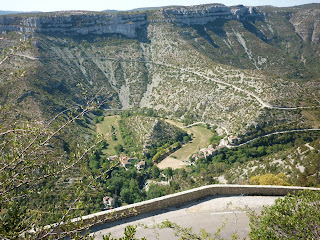
Navacelles at the base of the Gorges de Vis


Navacelles is a quaint little town and we had lunch close to the waterfall where the Vis suddenly emerges again - I still have to find out where the course of the river is, because the gorge looks as if it ends in a blind valley and although there is an aqueduct somehow it wasn't apparent where the source rises. Our little toy car strained up the steep pass with Conal warning that we'd have to descend again - and indeed we no sooner reached the top of the escarpment than the road dipped - this time fortunately a slow decline eventually driving along yet another beautiful valley whizzing past XIthC churches and Roman bridges - I would have loved to stop but once behind the wheel, Conal has the habit of only stopping when once he has reached his destination.  On our trip we drove along three different rivers, the Arre, Vis and finally the Herault River.
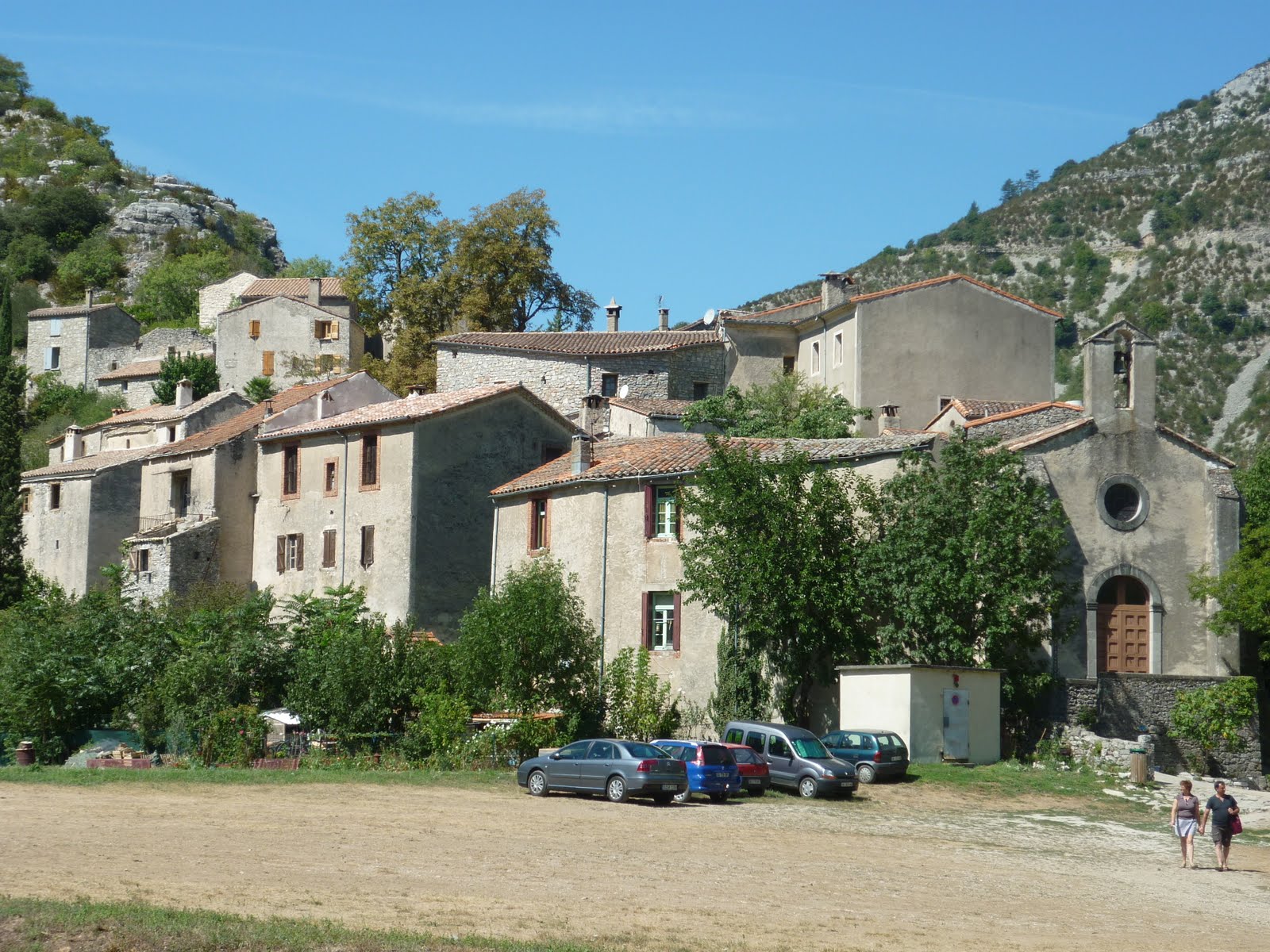
The village of Navacelles


Although the gorge is not as vast as the canyon we saw in Utah, it is spectacular in it's own way and of course being able to drive to the base of the gorge and being dwarfed by the height of the mountains gave us another perspective. Certainly worth the journey - although I would hesitate to take anyone who suffers from car sickness along the route. 

Conal says this is one of the descendants of Modestine - the name of the donkey in Robert Louis Stephenson's book we're reading - grazing in the field next to our house in Espigarie


Monday, 29 August 2011

ENCORE FRANCE

Cafe des Cevennes where we have our daily coffee

Centre of Le Vigan

Le Vigan has 10,000 inhabitants - in summer this doubles and with August drawing to a close the town is emptying as people leave for their journey home. However when we went into town on Saturday we found it transformed - it was market day, the whole town was buzzing and we had to wait patiently for parking. We wandered around looking at the local produce including chickens in coop an then decided to drive to a little village called Brieu where we'd been told that there was an auberge that served delicious meals. I wandered into the restaurant to find it deserted and in fact it I suspect that the whole village had gone to Le Vigan to the market. 

View from Auberge la Borie where we had Sunday lunch


Yesterday we decided to go to Mangadout  for lunch, yet another village along tortuous roads where the restaurant is perched on the edge of the mountain with wonderful views across the valley. We had a delicious meal - and staggered back to Paillerols with Conal driving with the added confidence of a full stomach. 

We've been hearing a donkey braying and on our walk yesterday found the rather handsome animal grazing happily in the field nextdoor - accompanied by a number of Isa Brown chooks. I'm about to start a book recommended by Sara called Travels with a donkey in Cevennes written by Robert Louis Stephenson so was thrilled. 

Friday, 26 August 2011

LE VIGAN AND SURROUNDS


St Martial in the rain


Anna says that it sounds as if we've landed up in Jean de Florette country - and indeed that's exactly what it feels llike. Our days here continue to delight - the past two days have been rainy and the valley is clothed in mist. Our routine is to drive into Le Vigan to the cafe for our daily coffee au lait and croissant while we check our mail. We had planned to go to the biggest gorge in Europe yesterday but thought it might be better to do that on a good day, so armed with delicious bread, brie and baby tomatoes we set off for a little circular drive through the village of Ganges up into the mountains. This area used to be the centre for the silk industry and so there are huge ancient stone mills dotted around. Sadly it was so misty that our visibility wasn't great and the roads so narrow that we had to concentrate as we climbed up the steep pass and then we had to have our picnic in the car. Guess you can't strike it lucky all the time!  Conal is getting the hang of the roads although I still have to remind him to stay on the right sometimes - but he seems far more confident driving although found it a bit nerve wracking on the narrow passes in the rain. He is enjoying pottering around the farm - fixing things and putting in new globes where necessary. We go for little walks around our area called Paillerols and found a path taking us along the contour where the hill side has been terraced with stone retaining walls - terrace upon terrace all overgrown.


Duck a la Conal


We wandered across to thank Ani for letting us in and met her husband Omer Faidherbes. They are both well-known artists who have had numerous exhibitions - he paints landscapes and has done a series of botanical water colours for books while she does outlandish wooden sculptures and all manner of patchwork out of wonderfully rich fabrics. The curtains in our bedroom have been made by her. They are both such interesting people and we had a lovely time looking at his studio and art - and Ani showed us her work as well. 

 We are surrounded by fig trees and even I can't keep pace with all the ripening figs - huge walnut trees, apple trees, vines, pears & olives - the list just keeps growing. And the bird life entertains Conal - he spotted a pair ospreys flying overhead and a paradise flycatcher visiting the fig trees. 

Tuesday, 23 August 2011

RURAL LANGUEDOC


Our trip from Bern to Nimes was hugely enjoyable - we had to change trains twice and being seasoned travellers with our small bags it was easy. We arived in Nimes at 3 pm and collected our little car at the station. I tried to persuade Conal to get a GPS but that would make it too easy for him - and he is a great believer in making things challenging. I thought driving on the right would be enough of a challenge. Anyway with a great deal of trepidation we set off for Le Vigan. I do think the angels must have been watching over us because other than Conal side-swiping the kerb, we found our way out of Nimes and onto the road to Le Vigan with me constantly reminding Conal to keep to the right. The road was well sign posted and we drove through countryside that kept getting more beautiful, through a gorge. and arrived in the village in time to stock up with groceries and set up the narrow road to Les Paillerols a village consisting of about 3 houses where we managed to find Annie who came with us to open up the house. 
View from the house


The farm house is perched high in the mountains is HUGE and old - with crumbling walls. It was renovated about 30 years ago and is quite comfortable and must have been lovely while Evelyn was alive. Sadly it now has a rather unloved look about it  with things dumped in cheerful confusion on every surface - but as Jan would say "what the hell Michelle". It took Conal's ingenuity to get us set up - we took rust encrusted keys to locks to connect the water - and then down into a cob webbed cellar to find the electricity and hot water system. Lots of chatting from Annie in French - tres complique she kept saying - and trying to get by with my rather basic French - in between raiding the fig trees laden with the sweetest black figs - eventually we managed to sit down with a glass of French rose and an omelette eaten beneath the fig trees outside the kitchen.

Farm house - note the fig tree


We went into the village again this morning and walked into the central 'place' to a cafe for our coffee and croissants - then to the tourist information to get maps of the area, to a little market set amonst the old buildings - some dating from the 15thC and earlier. There's lots to explore and I anticipate that we're going to have lots of fun - this is the bread basket of France - olive trees, fruit trees and vineyards galore. Too many cheeses to chose from - and this is where pate de fois gras is made - ou-la-la! 

View from the farm